
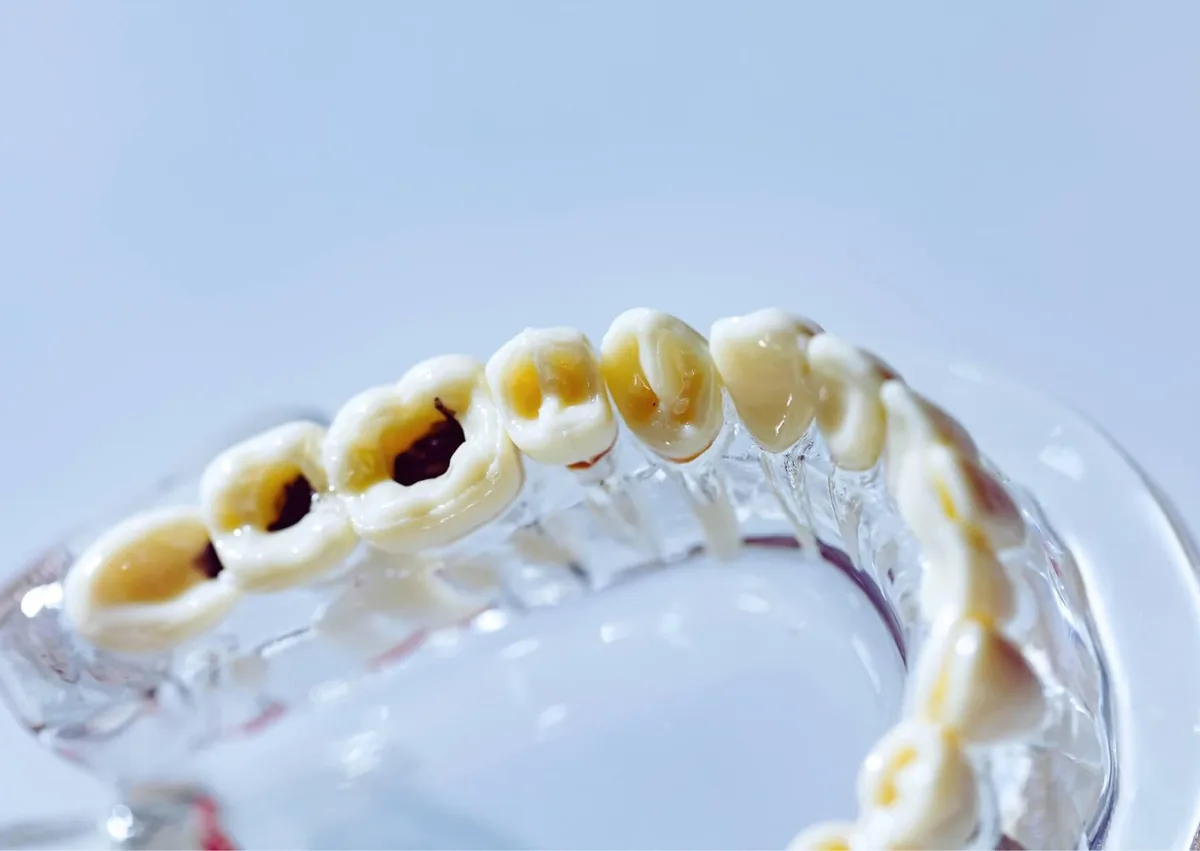
Cavities can look like chalky white spots, brown or black discoloration, small pits, rough areas, or visible holes. But many cavities are hard to see at home, especially when they form between teeth, under enamel, or around older dental work, so a dental exam is the most reliable way to tell the difference between a stain and active decay.
A dental exam can help identify early signs that may not be noticeable on your own. At CR Smiles in Katy, TX, we provide thorough dental exams to evaluate your teeth and gums, detect potential concerns, and help you maintain a healthy smile with personalized general dentistry care.
An early cavity often begins as a dull, chalky white area where minerals have been lost from the enamel, the tooth’s hard outer layer. These spots often show up near the gumline, around braces, or in the grooves of back teeth.
As decay progresses, the area may turn yellow, light brown, or dark brown. It may also feel rough or start to form a tiny pit that traps food, although color alone does not confirm a cavity.
|
Possible Stage |
What It May Look Like |
What It May Feel Like |
|---|---|---|
|
Early mineral loss |
Chalky white or dull patch |
Usually no symptoms |
|
Enamel decay |
Brown or dark spot, small pit |
Often painless |
|
Deeper decay |
Visible hole or broken edge |
Sensitivity to sweets, cold, or heat |
|
Decay near the nerve |
Larger defect or deep discoloration |
Persistent pain, pain when biting, or throbbing |
On molars, cavities may look like dark lines, dots, or pits in the natural grooves. Because healthy grooves can also hold stain, dentists often use an exam and X-rays to tell whether the enamel is actually damaged.
Between teeth, cavities usually cannot be seen until they are more advanced. In some cases, they create a gray or dark shadow under the enamel, cause floss to shred, or lead to repeated food trapping.
Near the gumline, cavities may look yellow, brown, or black and may have an uneven edge. Root cavities can spread faster because exposed root surfaces are softer than enamel, especially when gums have receded or the mouth is dry.
Decay around a filling or crown may appear as a dark margin, a gap, or a chipped area. Some cavities stay hidden under the restoration, so a normal-looking filling or crown does not always rule out a problem.
A dark spot is not always a cavity. Coffee, tea, tobacco, pigmented foods, tartar buildup, enamel variations, and older dental work can all change a tooth’s color.
A stain changes appearance without breaking down tooth structure, while decay damages the tooth itself. Do not scrape or probe a suspicious area, because that can irritate the gums or weaken already damaged enamel.
Cavities are also not always dark. Early decay may look white, and deeper decay may be hidden under a surface that still looks intact.
A dentist usually checks the tooth under good lighting, examines the surface, and asks about sensitivity or pain. Bitewing X-rays can help reveal decay between teeth or beneath restorations that cannot be confirmed by appearance alone.
If symptoms suggest a crack or deeper infection, additional tests may be used to check the nerve, bite, or tooth structure. The final diagnosis depends on the location, depth, activity of the lesion, and how much healthy tooth remains.
Very early mineral loss that has not formed a hole may sometimes be stabilized or reversed through remineralization, fluoride, better plaque control, dietary changes, and monitoring. These steps are also part of good oral hygiene.
Once a cavity creates a physical defect, the damaged area usually needs to be removed and restored with a filling. Larger areas of decay may need an inlay, onlay, or dental crowns to protect the remaining tooth.
If decay reaches the pulp, the soft tissue that contains the tooth’s nerves and blood vessels, a root canal may be needed before the tooth is restored; see root canal cost for more on that treatment.
If a tooth cannot be repaired predictably, tooth extractions may be necessary, although dentists generally try to preserve natural tooth structure whenever possible.
For a filling, the area is usually numbed with local anesthetic before the decayed tissue is removed and the tooth is cleaned and restored. Tooth-colored composite resin is often used, although the best material depends on the tooth’s location, bite pressure, cavity size, moisture control, and cosmetic goals.
Mild sensitivity or gum tenderness can happen for a short time after treatment. The restoration should feel comfortable when you bite, and its shape and shade can often blend closely with the surrounding tooth.
If your bite feels high or sensitivity does not improve, your dentist should recheck it. Treating decay early usually allows for a smaller, more conservative restoration.

Schedule a dental evaluation for a new spot, visible hole, repeated food trap, sensitivity, pain when biting, or a toothache that persists or worsens. A broken filling, swelling near a tooth, or a bad taste or drainage also deserves timely attention.
Seek urgent dental or medical care for facial swelling, fever, difficulty swallowing or breathing, swelling near the eye, or rapidly worsening pain. These symptoms may indicate a spreading infection and should not be managed by waiting for the tooth’s appearance to change.
For severe dental pain, injuries, or signs of a spreading oral infection, contact our emergency dentistry team for immediate attention.
Because cavities vary so much in color and visibility, an exam is the best way to separate harmless staining from active decay. A dentist can determine how much tooth structure is involved and whether the most conservative option is monitoring, a filling, or more advanced treatment.
If you’re experiencing tooth sensitivity, noticing changes in a tooth, or simply due for a checkup, schedule a dental exam to have your teeth evaluated for cavities and other oral health concerns. CR Smiles in Katy, TX provides general dental exams and preventive care for patients from Cinco Ranch and Fulshear. Call (281) 394-9600 to schedule your appointment.
Yes. A cavity can appear as a black or brown dot, especially in a molar groove, but a dark dot may also be a stain.
Yes. Cavities often form between teeth, beneath the enamel surface, or around existing restorations, where they may only be found during an exam and dental X-rays.
No. A chalky white spot can be early mineral loss, but it can also be caused by fluorosis, dehydration, or natural enamel differences.
No. Early cavities are often painless, while deeper decay may cause sensitivity, pain when biting, or spontaneous aching.
An early area of mineral loss may sometimes reharden before the enamel surface breaks down. Once a hole has formed, the missing tooth structure does not grow back and usually needs restorative treatment.